Agents Need a Pulse
Mina feels time pass. Today’s AI agents can’t. Here’s how to give them a System 1.
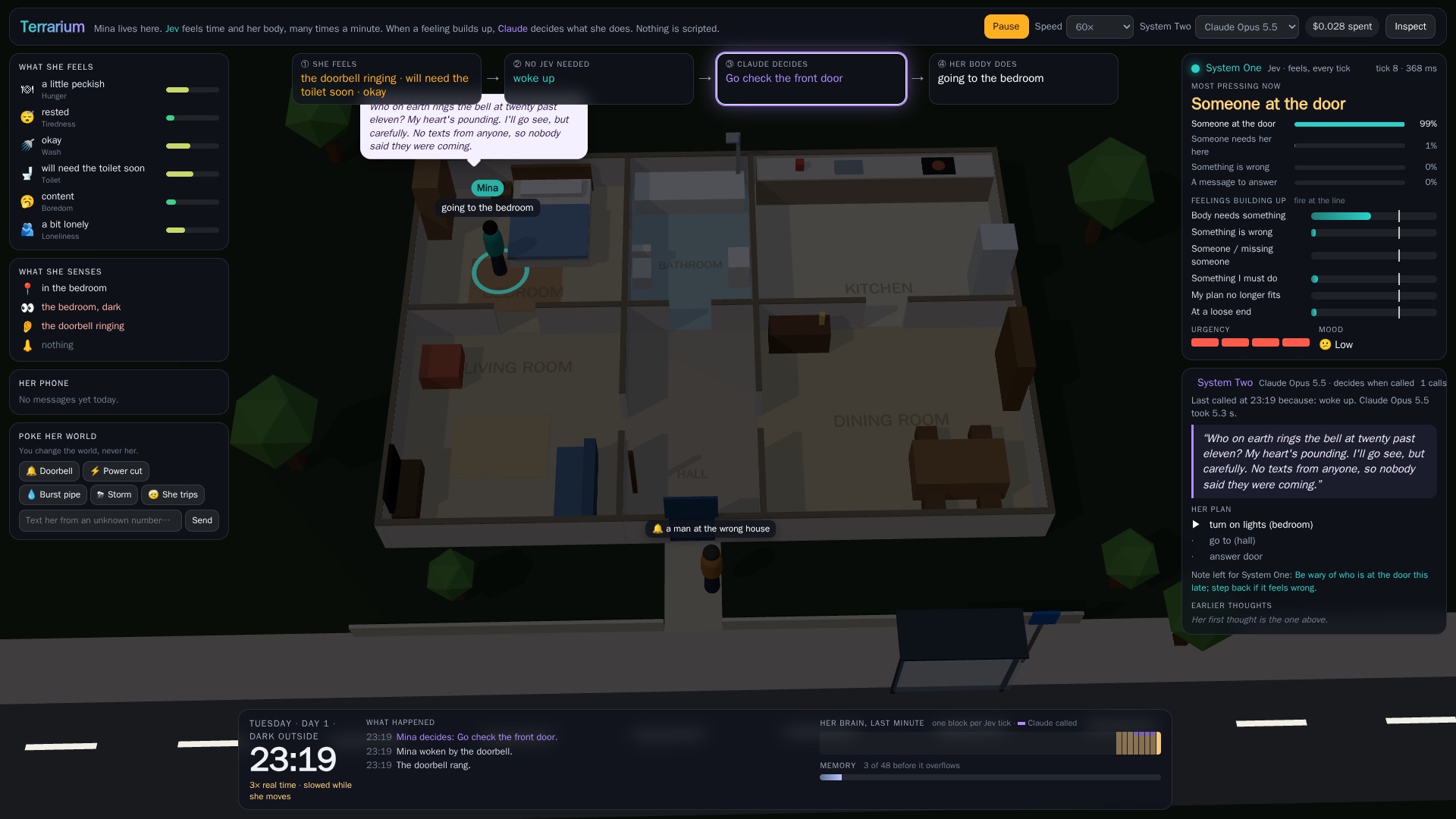
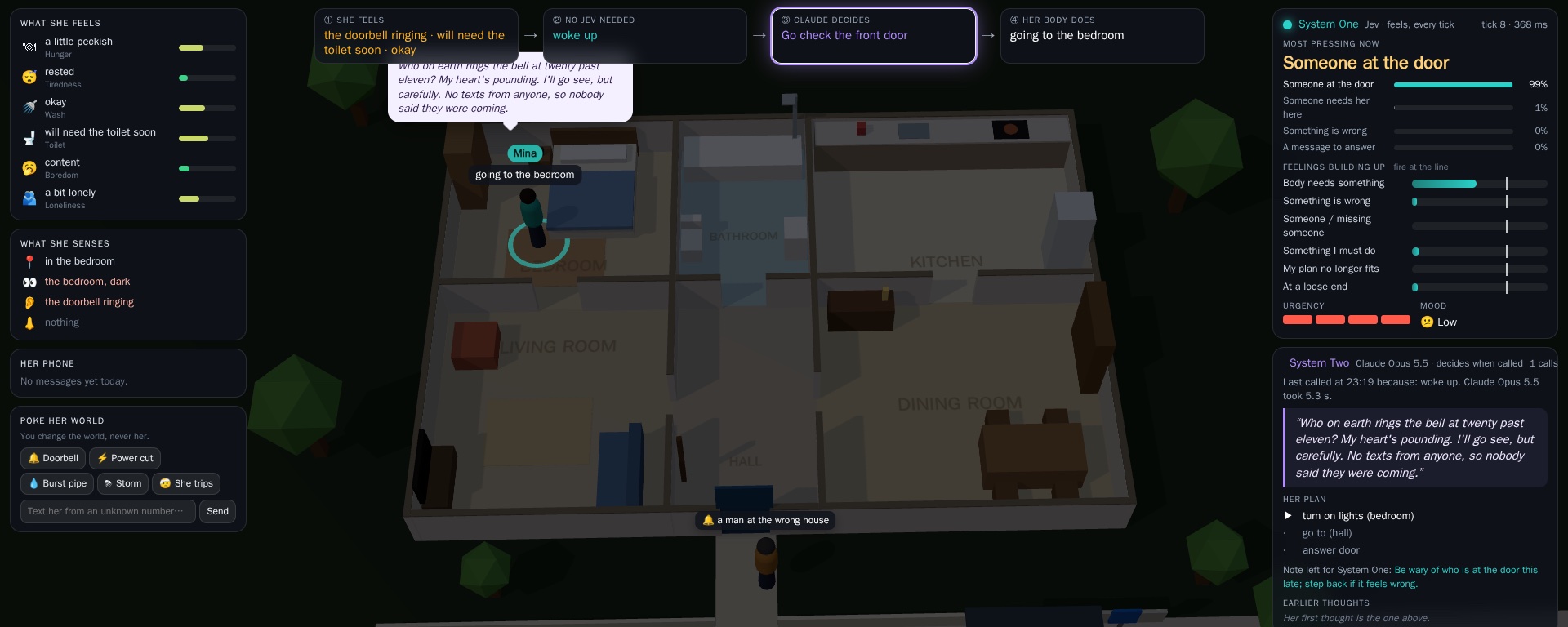 23:19. The doorbell wakes Mina. System 1: someone at the door, 99%. System 2: “Who on earth rings the bell at twenty past eleven? My heart’s pounding. I’ll go see, but carefully.”
TL;DR: Daniel Kahneman described two ways we think: System 1, fast and automatic, always on, and System 2, slow and deliberate, called in when needed. Today’s AI agents have only System 2. An LLM thinks brilliantly when asked and is frozen the rest of the time. So I gave one a System 1. Mina is an artificial person: TypeSafe’s Jev is her System 1, feeling her body, her senses and the clock every second for a fraction of a cent, and an LLM is her System 2, woken only when a feeling crosses its line. Nobody wrote her day. This is how I think the next generation of AI agents will be built. The code is public: github.com/kavehmz/mina-terrarium.
Agents today have only System 2
To run my home or my office, an LLM would have to be asked, every second: is there something to do here? That is too slow and too expensive. So it waits for a prompt, and between prompts nothing in it is awake.
I am not built like that. Part of my brain ticks all the time. It feels the clock, the light, hunger, a sound, and notices that nobody has called. Kahneman calls it System 1. Only now and then does it hand something to System 2, the slow part that thinks.
Jev is fast and cheap enough to be that System 1: about 330 ms and a fraction of a cent per look. TypeSafe even named it after Kahneman. So Mina gets both systems.
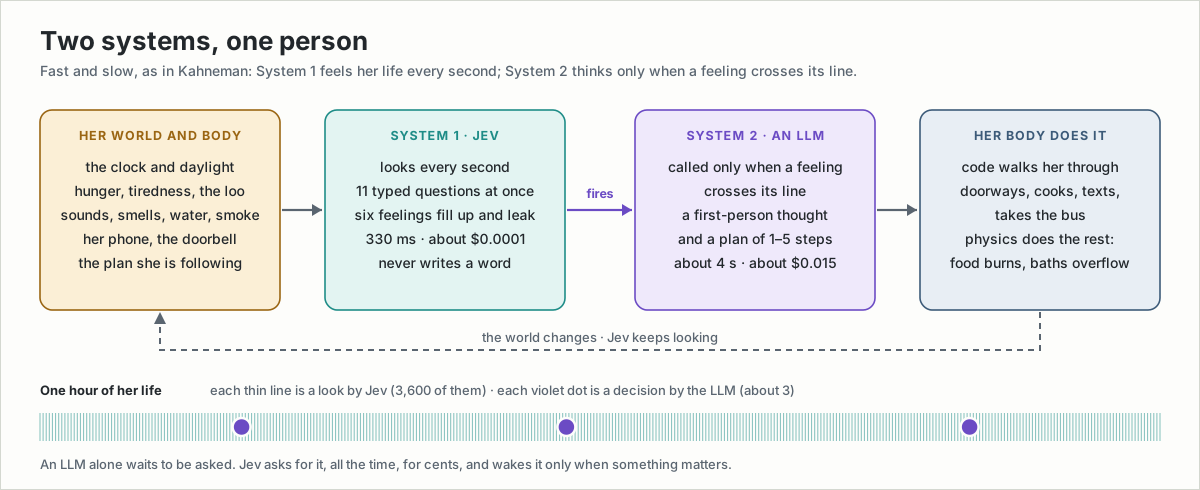 Two systems, one person
- System 1 (Jev) looks every second. It reads her state (the clock, her body in words, what she sees and hears, her phone, her plan) and answers 11 typed questions at once. Six of them are feelings.
- System 2 (an LLM) is woken only when a feeling crosses its line. It answers as Mina: a thought in her own words, and a plan of a few steps.
- Code carries out the plan. She walks through doorways, cooks, texts, takes the bus.
Watch a feeling fill up
System 1 has one job: to decide, every second, whether something is worth waking System 2 for. It never decides on one look. Each feeling fills a little with every look and leaks a little. One blip never fires; a feeling that lasts does.
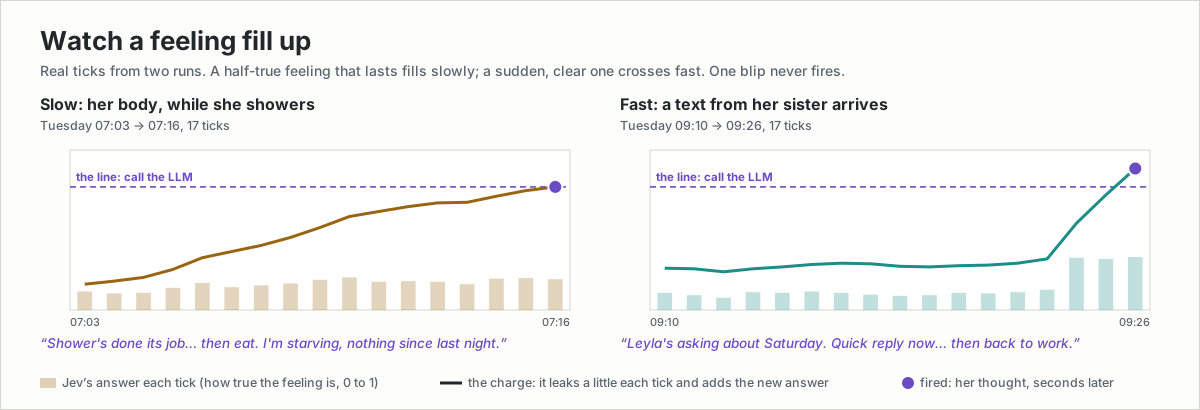 Watch a feeling fill up
On the left, her body needs something at about 0.4 each look while she showers. System 1 lets it build for 17 looks, then wakes System 2, and she thinks about breakfast. On the right, a text from her sister lands, and the feeling crosses the line in three looks.
Nobody wrote this
A burst pipe, mid-breakfast. Since she woke, System 1 had looked 38 times without firing once. One look after the pipe burst, it fired: something is wrong, 100%. System 2:
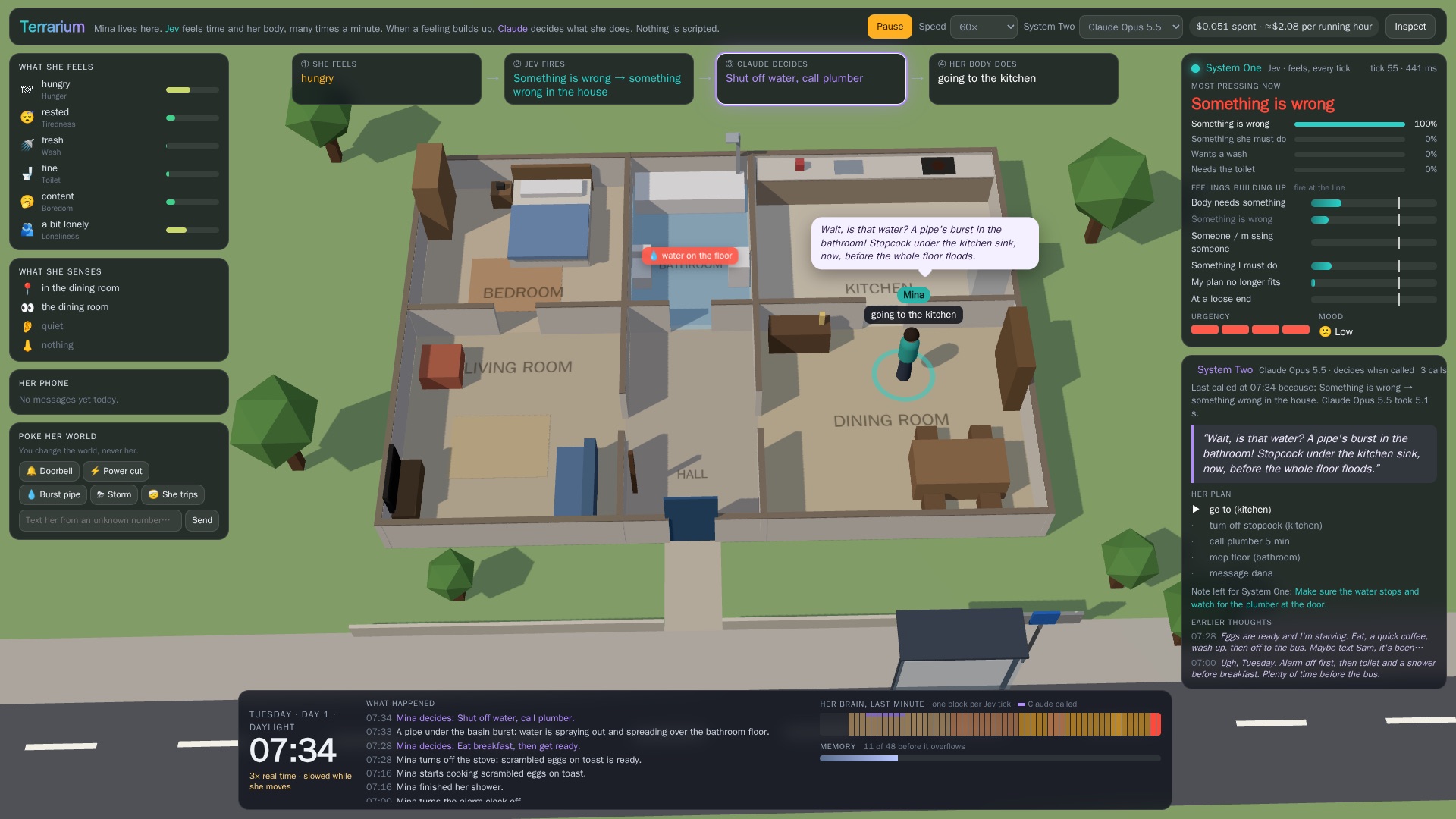 A pipe bursts while Mina eats breakfast
“Wait, is that water? A pipe’s burst in the bathroom! Stopcock under the kitchen sink, now, before the whole floor floods.”
She shut the water off, mopped, called a plumber and texted her manager she’d be late. From the burst to the fixed pipe: 220 looks, 9 thoughts.
“Right, floor’s mopped, Dana knows, plumber’s coming around ten. My eggs are gone and I’m starving. No water for coffee, annoyingly.”
A stranger at the door, 23:19. Asleep, System 1 still looks, every three seconds, and stays quiet. The doorbell woke her; the world did that. From the bell back to sleep took 14 looks and 2 thoughts.
 The doorbell at night
“Who on earth rings the bell at twenty past eleven? My heart’s pounding. I’ll go see, but carefully.”
“Just some lost man looking for number 14. My heart’s still racing. Door’s locked again, loo, then back to bed — work tomorrow.”
A fall. I tripped her up, with the front door locked. System 1 fired on the pain and kept firing as things changed: 119 looks, 7 thoughts in forty minutes of her life. She phoned her sister, a nurse, who told her to stay put and drove over. Then the doorbell:
“Leyla said stay put, so stop trying to stand. She’s driving over — she’ll need to get in, but I can’t reach the door, so I’ll text her and wait.”
“She’s still ringing — the key must not be working. I can reach the latch from the floor if I shuffle over; just open it.”
She crawled to the door, and her sister helped her onto the sofa.
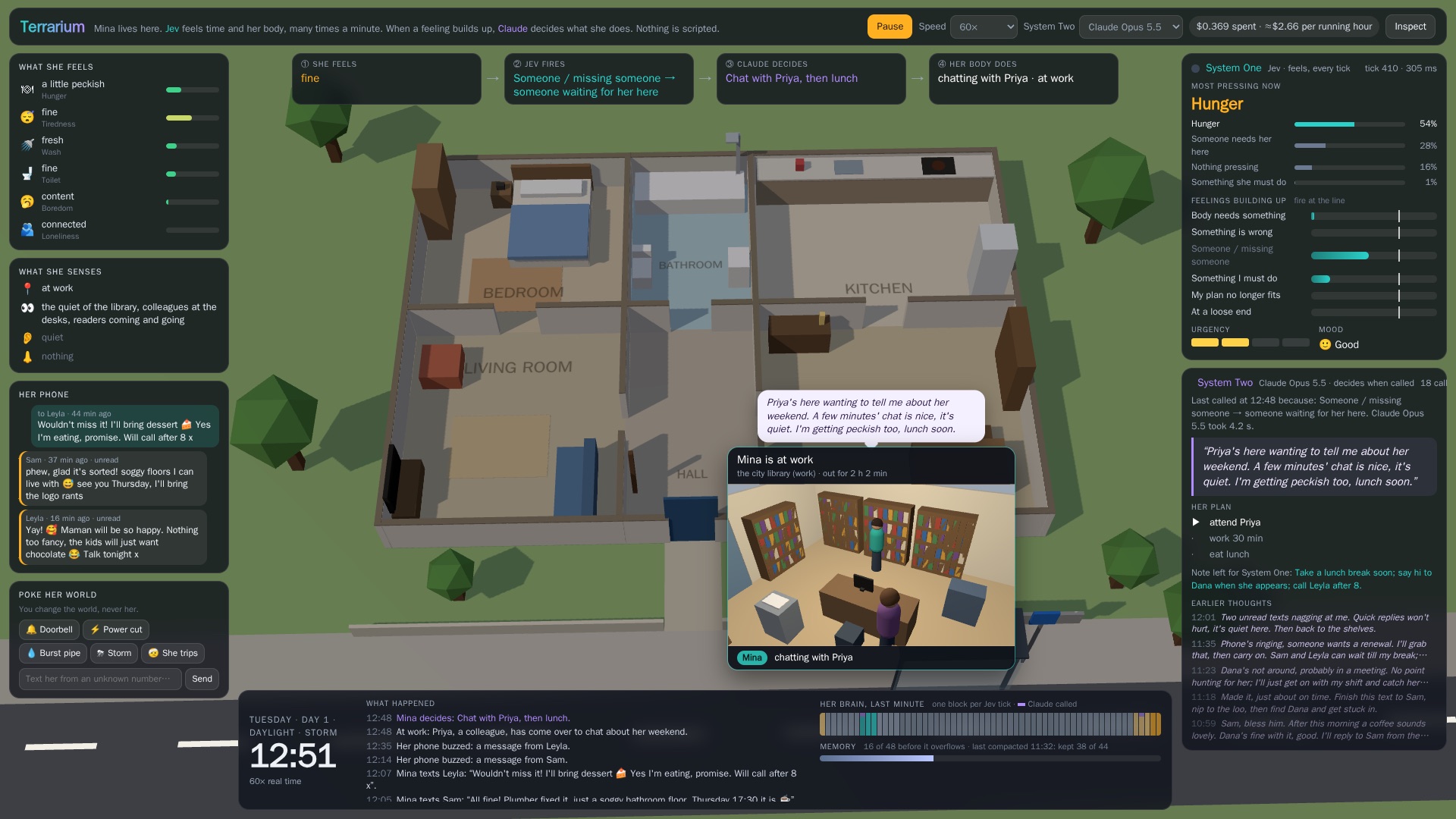
A morning at work. When she’s out, a small window shows where she is. Two hours at the library: 145 looks, 7 thoughts: the desk phone, texts from her friends, a colleague stopping by. The rest of the time, System 1 let her work.
 At the library
“Priya’s here wanting to tell me about her weekend. A few minutes’ chat is nice, it’s quiet. I’m getting peckish too, lunch soon.”
Who owns what
 Who owns what
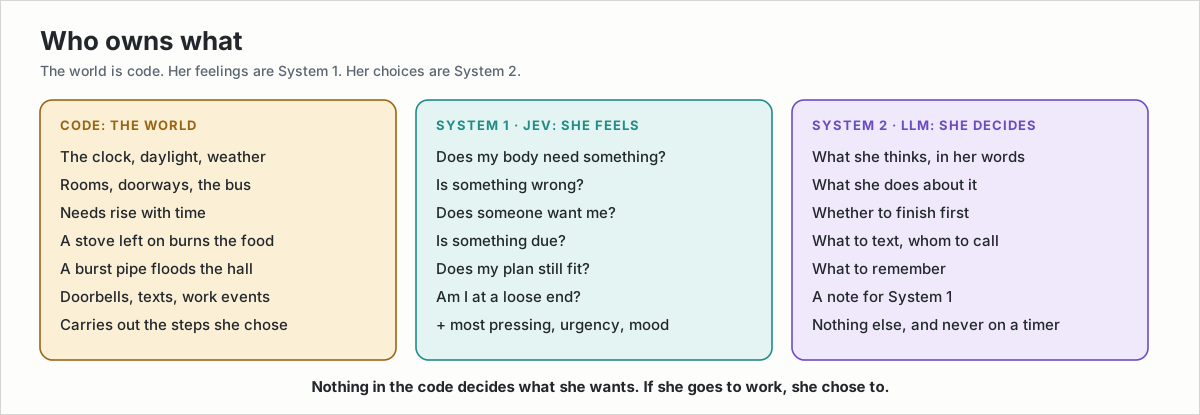
The rule was strict from the first day: code owns only the world. Physics, senses, needs that rise with time, a stove that burns food if she walks away. No routine table, no schedule. If she goes to work, she chose to.
Her morning, by the numbers
 Her morning, by the numbers
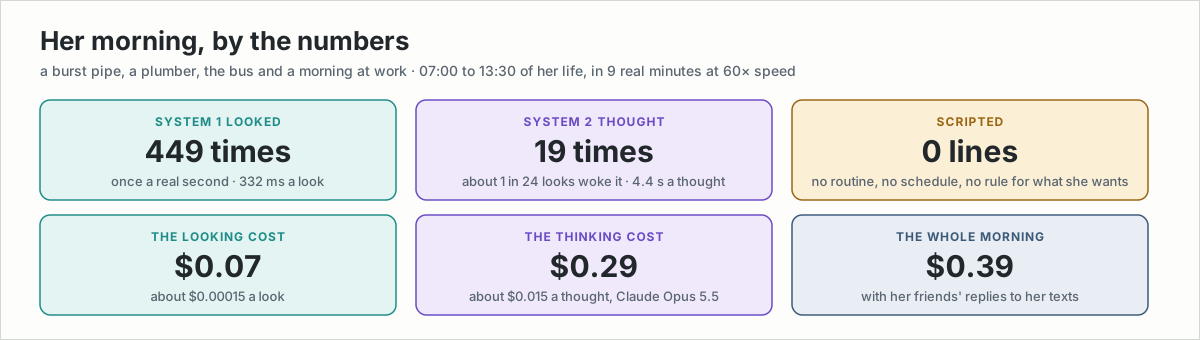
She lived seven hours in nine real minutes. System 1 looked 449 times and woke System 2 only 19 times, about once every 24 looks. The looking cost 7 cents; the thinking cost 29. That ratio is the whole idea: watch constantly and cheaply, think rarely and well. You can even switch System 2 while she lives: with GPT-6 Luna a thought costs about $0.0004.
Watch her live
Eighty-seven seconds from two live runs, cut together. No sound. Every thought on screen is word for word from the logs.
How to build an agent like this
Five rules I learned building Mina. None of them is about her; all of them are about agents.
- Give it a heartbeat. A System 1 that looks at the whole state every tick, with typed questions, not prose.
- Let feelings build. Each look adds a little and leaks a little. Wake System 2 at a line, never on one blip.
- Wake System 2 only for something new. Once it has weighed a feeling, let that feeling rest unless the situation changes. Without this rule, Mina re-thought her tired afternoon every twelve minutes: “Nothing’s changed — still shelving, still tired.”
- Keep the world out of the model. Facts, physics and consequences live in code; the LLM only chooses. When it invents a fact (a spare key that doesn’t exist), the world simply doesn’t have it.
- Slow the clock while it thinks. A five-second thought should cost five seconds of the agent’s world, not five minutes.
Why it matters
Every agent I use today is System 2 only. It waits for a prompt, answers brilliantly, and freezes. It cannot notice that the stove is still on, that a customer has waited twenty minutes, that a server went quiet, that nobody called. Not because it isn’t smart, but because nothing in it is awake.
Mina is a toy. The pattern is not. The next generation of agents will have both systems: a System 1 that is always awake and cheap enough to look every second, and a System 2 that thinks only when System 1 says it matters. If you are building agents now, start building them like this.
We have spent years making LLMs smarter at answering. The next step is giving them a pulse.
Code, the brief and the run notes: github.com/kavehmz/mina-terrarium.
Previously: Every Team Its Own Language · The Spec Factory · Cognitive Programming Language
Posted on September 23, 2026