Books That Fit the Reader
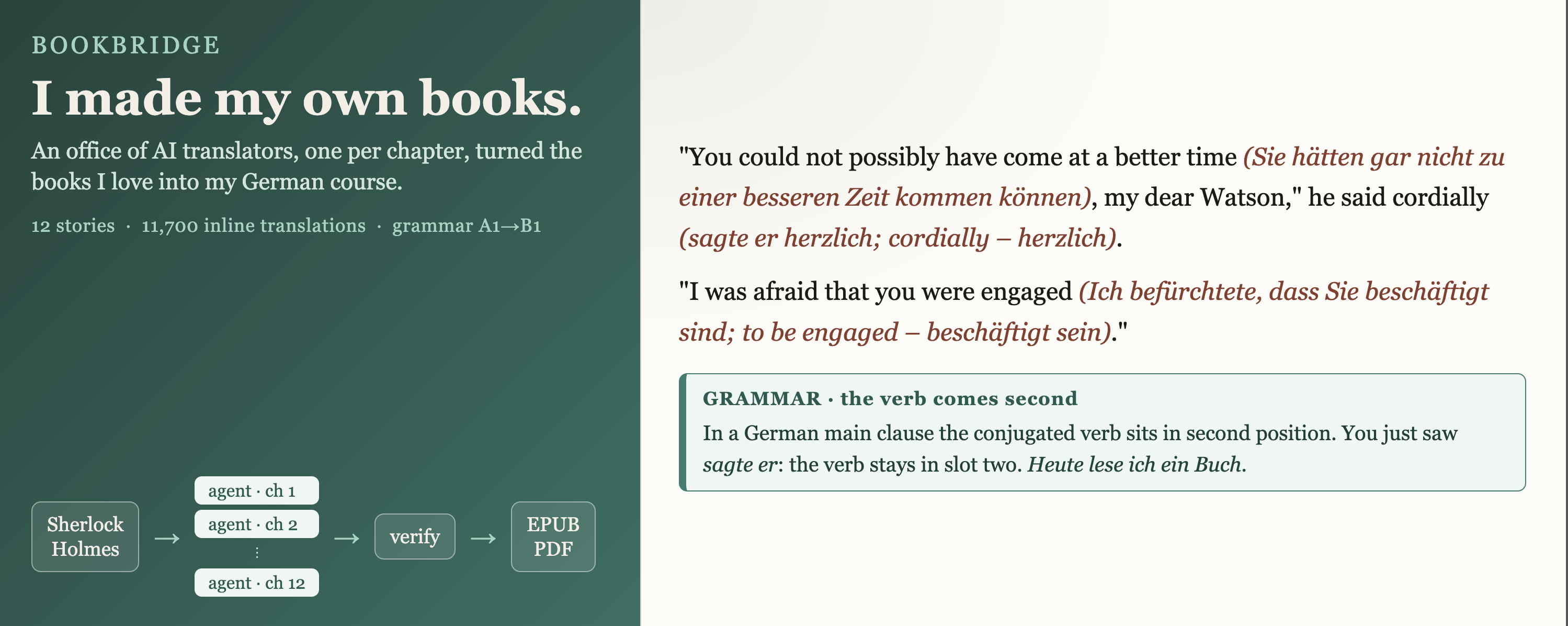 BookBridge: an office of AI translators, and the book it made
TL;DR: I learn languages by reading books I love, not from textbooks. That is how I picked up English. For German I had far less time, so I used Claude Code to build myself exact, tailor-made bilingual books: my choice of book, my translation style, my grammar, my pace, down to the smallest detail. I have come to believe this, AI shaping what you learn from to fit who you are, is the most important thing AI does for us.
How I learned English
The first time around, I never used a textbook. I just got hold of English books I wanted to read, ignored the small fact that my command of English was poor, and started reading with a dictionary at hand.
The list was not a curriculum. It was whatever I was hungry for: Algorithmics, Math, Physics, Combinatorics, Sherlock Holmes, Dune, The Hitchhiker’s Guide to the Galaxy, Ender’s Game, The City and the Stars. Some of it was textbooks, some of it was science fiction. None of it was chosen to teach me English.
That is the whole trick. It was never English that was dragging me forward, it was the books. I wanted to know what happened next badly enough to push through sentences. The language came along as a side effect. By the time I had read enough, my English had quietly become better.
German, same plan, less time
So for German I decided to do the same thing. Get the books I love, start reading, let the language follow.
The plan is the same. My life is not. This time there is more work, a family, and a long list of other subjects I also want to read about. The evenings I used to spend with a novel and a dictionary are mostly gone. The dictionary-in-hand method is wonderful when you have a whole evening. It is painful when you have twenty minutes and every third word sends you to look something up.
I needed the same immersion, but with much less friction per page.
Along the way I found bilingual readers, and one style in particular: the original text flows normally, and the translation is woven in right after each small phrase, so you almost never have to stop. It is a good format, and exactly the right shape for someone short on time.
But it was never quite my book. Someone else chose the title. Someone else decided how much help to put on the page, whether there was any grammar at all, how literal the translation should be, what reading level it assumed. Close to what I wanted, but not mine.
So I decided to make my own. The appeal was control. I choose the book, and I decide how it works: how the German reads, idiomatic rather than word-for-word; how much vocabulary help sits on the page; whether grammar is taught alongside the story, and at what level and pace; whether the notes are light or heavy. Every detail set the way I want it.
Build it
The format I settled on is the one I liked best: English flows normally, and after each small chunk the German appears inline, in a warm colour, with a short note whenever a word is irregular or idiomatic, and a literal hint when the German reorders the sentence. Here is a real paragraph from the result:
It is difficult to know quite where to begin this story (Es ist schwierig, genau zu wissen, wo man diese Geschichte beginnen soll), but I have fixed my choice on a certain Wednesday (aber ich habe mich für einen bestimmten Mittwoch entschieden; to fix one's choice on – sich entscheiden für).
"You could not possibly have come at a better time (Sie hätten gar nicht zu einer besseren Zeit kommen können)," he said cordially (sagte er herzlich; cordially – herzlich).
That teal box is the second thing I wanted: grammar, but on my terms. A short note every few pages, each one tied to a sentence I just read, the whole sequence ramping from A1 up to B1 across the book. Not a grammar chapter I have to sit through, just a small explanation arriving exactly when the story has shown me the thing it explains.
Here is what it looks like on a real page, and a grammar box in context:
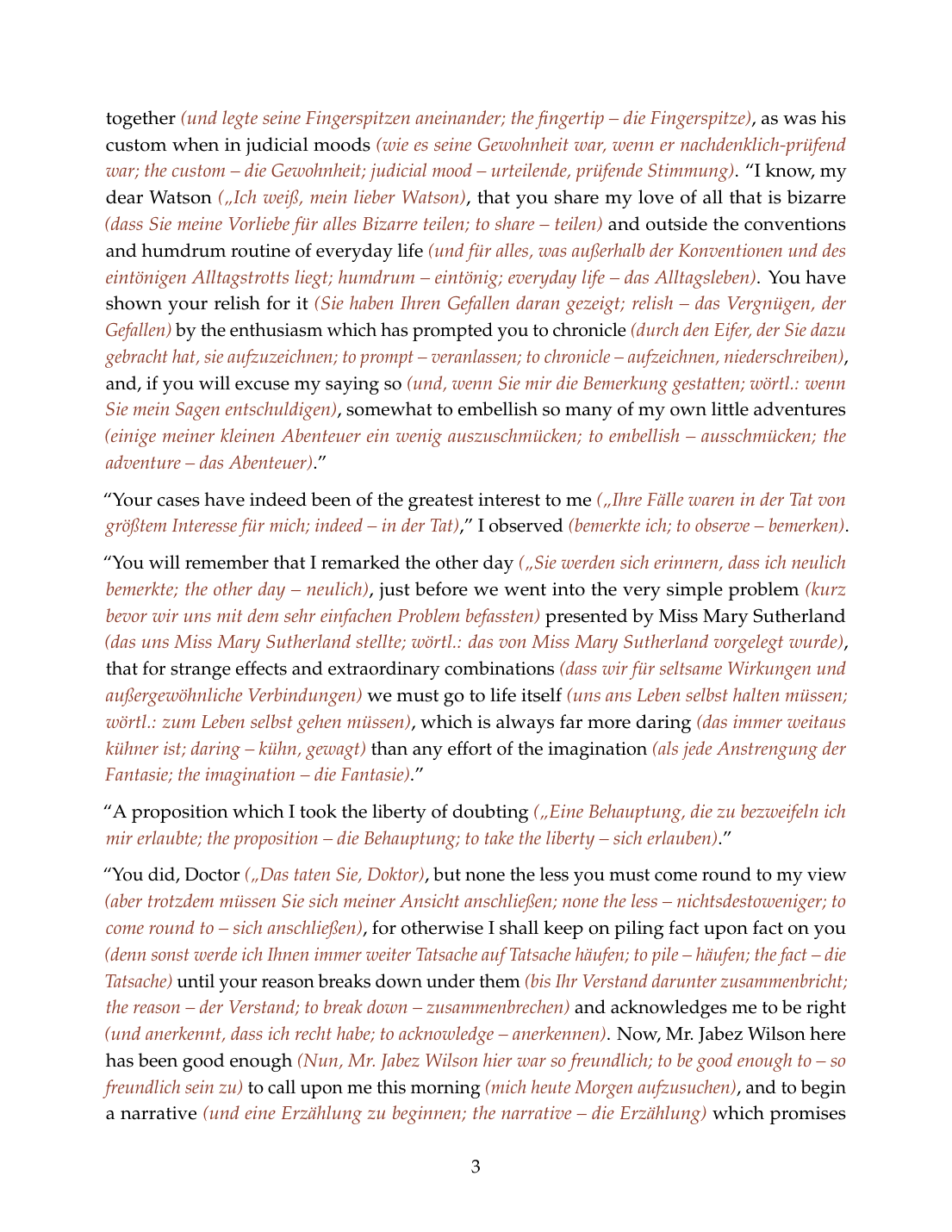 A bilingual page: English with the German woven in
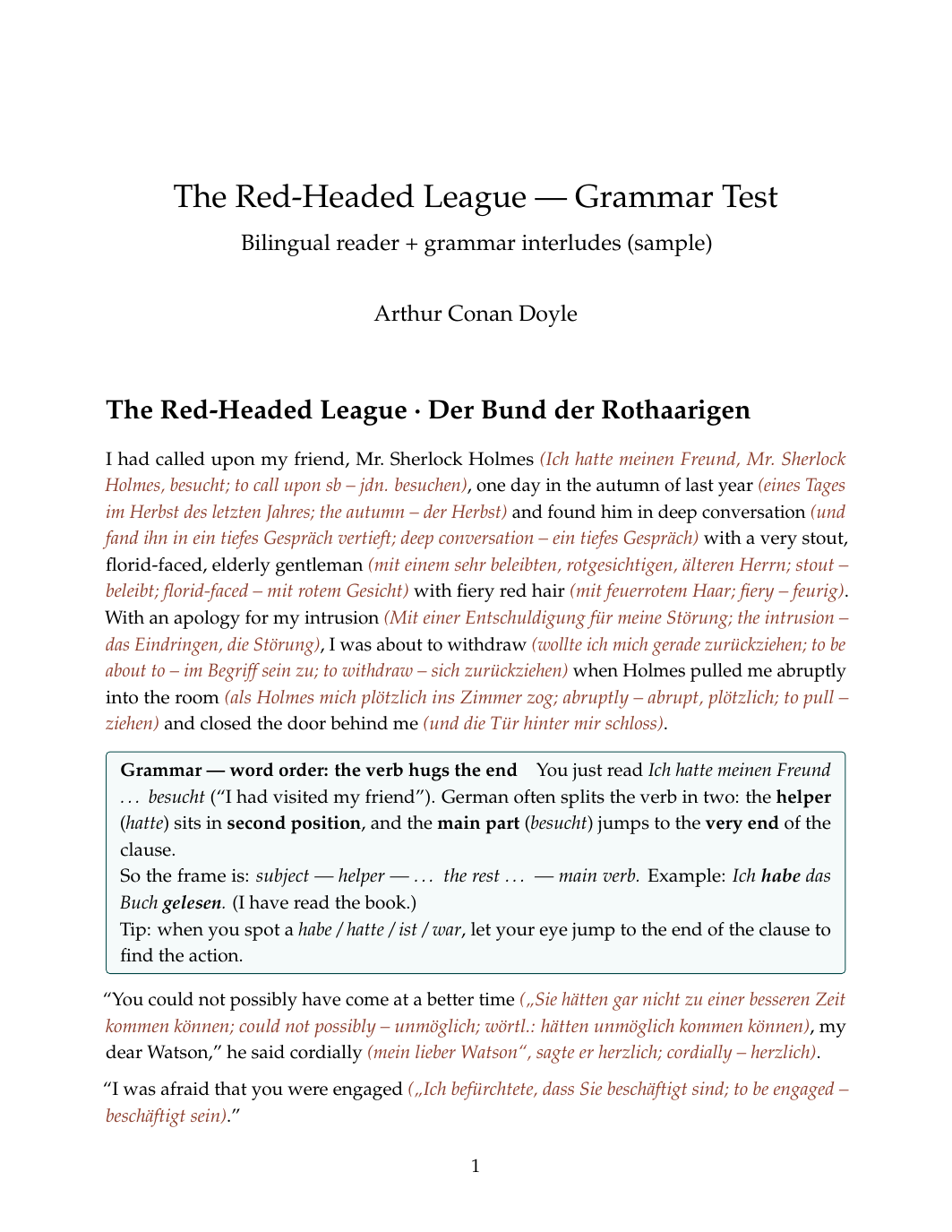 A grammar box dropped between paragraphs
The office of translators
A whole novel is too big to translate in one pass, and quality drops if you try. I used Claude Code with the prompts you can find in the repository linked below. Claude Code fans the book out to a fleet of sub-agents, one per chapter, all translating in parallel, then checks their work, re-runs the few that come back malformed, stitches everything together, and builds a PDF and an EPUB inside a container so nothing is installed on my laptop.
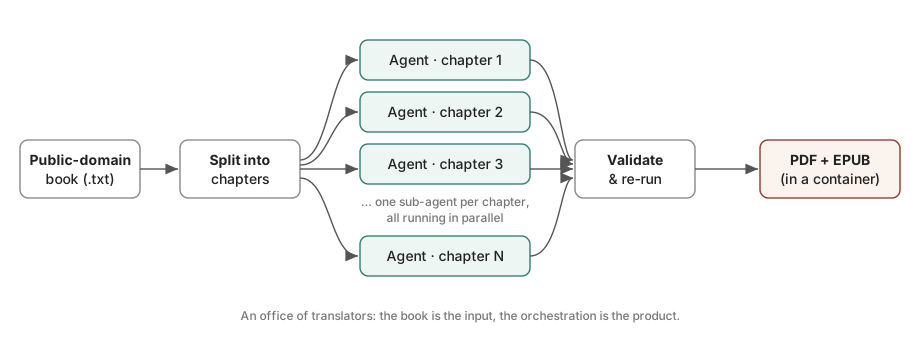 One book in, a fan-out of chapter agents, validate, then PDF and EPUB out
The output of one session was a complete Sherlock Holmes reader: twelve stories, English throughout, German woven into every sentence, and a grammar course folded in that grows from genders and word order to subordinate clauses and the genitive. It is on my Kindle now.
And because the whole recipe lives in the repo as plain instructions, the next book is one sentence away. I say which book and what grammar level, and the office runs again. The durable thing here is not the book, it is the process that makes books.
The recipe is open at BookBridge, and the exact Sherlock Holmes reader from this post is there to download, in EPUB and PDF. The book itself is public domain; the German and the grammar notes are AI-made and unofficial, so treat them as a study aid, not a reference.
Why this is the future of learning
I want to say this plainly, because I believe it. If AI does one thing that is clearly good for us, this is it: it lets the material fit the learner, instead of forcing the learner to fit the material.
The textbook was always a compromise. Printing is expensive, so we made one book for everyone and asked millions of different people to meet it in the middle. That compromise is now optional.
Think about who that helps. Someone with dyslexia who needs shorter lines and more spacing. A slow reader who wants fewer new words per page, and a fast one who wants more. A child who only keeps going if there is a story. An adult who wants the math, but with a light, funny voice carrying it. A learner who needs every idiom spelled out, and another who finds that patronising and wants it stripped away. None of these people are served well by the single average book. All of them can be served by a book generated for them.
I did this for German and reading. The same move works for almost any subject. The book can finally bend to the reader.
My wish
Two caveats, because I do not want to oversell it.
First, it is machine translation. It is very good on common phrasing and idioms, and good enough that I learn from it every day, but it is not flawless, and I label my editions as AI-made and unofficial. For my own study that is exactly the right trade. For anything I would hand to a stranger, I would want a human pass.
Second, and bigger: I can only do this freely with books that are old enough to be in the public domain, roughly a century. Arthur Conan Doyle is fair game where I live. Agatha Christie, who died in 1976, will not be until 2047. So my tailored library is really a museum. I can reshape the classics, but not the book that came out last year, which is often the one I actually want.
Imagine if recent books could be tailored too, legally, with the money and the credit flowing back to the original authors, and perhaps a small share to whoever did the tailoring. Every title available not in one fixed shape, but in versions that fit you: your language, your level, your pace, your need for humour or quiet or extra scaffolding. The same novel as a gentle A1 bilingual reader for me and as a dense, note-free text for someone fluent. The same textbook with three different voices.
The technology to make that is already here. The missing piece is the rights plumbing, a clean way to license a work for personal reshaping and pay for it fairly. I hope we build that, because the explosion of ideas that follows would be worth watching. We have spent a long time arguing about AI taking things from creators. This is the opposite: a reason for more people to buy more books, in more forms, because the book finally meets them where they are.
For now, I will keep reading Sherlock Holmes in German, twenty minutes at a time, in a book that exists only for me. That is what I wanted all along. Not a better textbook. No textbook at all.
Posted on June 6, 2026